
Ah, August–a month frequently associated with long, sun-drenched days, late-summer warmth, and the peak of the growing season. Reflecting this vibrant time of year is its traditional birthstone, the peridot, a gemstone admired for its distinctive green color that ranges from bright lime to a rich olive. Formed deep within the Earth’s mantle and even occasionally found in meteorites, peridot has fascinated people for thousands of years. Ancient cultures believed it symbolized protection, prosperity, and renewal–making it a fitting emblem for a month that represents abundance and the transition from Summer toward Autumn (which, if you’re like me, is a very welcome transition indeed!).
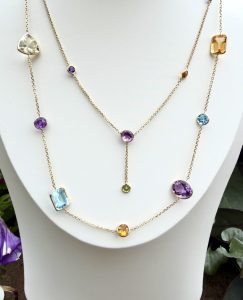
These pretty gemstone necklaces are currently priced to sell in our Estate and Consignment Collection cases! The top necklace features a bezel set peridot sparkling in the Y-shaped drop center ($700) along with other bezel set gemstones on the chain, while the bottom necklace ($800) features a peridot sparkling alongside a mixture of other beautiful gemstones. The true definition of eye candy, these necklaces won’t last long at these prices!
What is a Peridot–and How Do I Care for It?
While August technically has three birthstones–Peridot, Spinel, and Sardonyx–Peridot is, by far, the most well-known of this month’s birthstones. It’s known for its very vivid lime-to-olive green color, which makes it quite distinct from another popular green gemstone, the emerald (see our blog post about May’s birthstone for information about emeralds!). Peridot is part of the Olivine mineral famly, and clocks in at a 6.5-7 on the Moh’s Scale of Hardness, which makes them a slightly softer gemstone than quite a few we have examined in this blog series this year. It is a very lustrous, glassy stone, and–unlike other gemstones, like emeralds and sapphires–peridot only comes in shades of green. The exact shade of green is determined by how much iron is present in the stone.
Peridot has been mined for over 3,500 years. Ancient Egyptians referred to it as “The Gem of the Sun”, and they believed it had a wide range of functions, such as warding off nightmares, repelling evil spirits, and glowing after a sunset. Interestingly enough, many historians believe that some “emeralds” that were worn by Cleopatra were actually peridots.
Peridots today are typically sourced from Arizona, Pakistan, Myanmar, China, Vietnam, Tanzania, and Egypt (where there are historic mines). Interestingly, Arizona produces a large share of the world’s commerical peridot. Because peridot is a softer gemstone, it’s important to take special care of it. Make sure to avoid harsh impacts, keep it away from strong acids, and ultrasonic cleaners are not recommended. To clean your peridot jewelry, simply clean it with warm, soapy water, and make sure to dry it with a soft cloth. As with other softer gemstones, make sure to store your peridot jewelry separately from harder gemstones, such as sapphires and diamonds, to avoid scratching.
Fun Facts about Peridot…and How to Wear It!
Peridot gemstones can look especially beautiful set in a variety of precious metals. A yellow gold setting can add a warm, classic look to this gorgeous gem, while white gold can give a higher contrast look and rose gold can give a soft, more modern appearance. While larger peridots (over 10 carats) are uncommon, the largest cut peridot weighs over 300 carats! Tiny peridot crystals have been found in comet dust, and some beach sands in Hawaii contain green olivine crystals from volcanic activity, though collecting them may be restricted. And, for those who are fascinated by space, peridot might be the perfect gemstone for you: scientists have found olivine in meteorites, lunar rocks, and even Mars (though this was detected remotely!). It’s pretty special to think that this unique mineral exists beyond our Earth!
A Bit About August’s Other Birthstones
Curious about August’s other birthstones, spinel and sardonyx? Read on to learn more!
Spinel:
- Spinel became an official August birthstone in 2016
- For centuries, people mistook spinel for rubies because both can be bright red–some of history’s most famous “rubies” are actually spinels!
- Spinel occurs naturally in many colors–red, pink, purple, blue, lavendar, grey, black, orange, and violet. Unlike many other gems, spinels colors are usually natural rather than heat-treated!
- Spinels have a hardess of 8 on the Moh’s Scale of Hardness
Sardonyx:
- The original birthstone for the month of August
- A highly durable, banded gemstone that combines alternating layers of brownish-red sard and white or black onyx
- Sardonyx ranks 6.5-7 on the Moh’s Scale of Hardness
- The most popular stone for signet rings in Ancient Egpyt and Ancient Rome because hot wax never sticks to it!
- Sardonyx is highly sought after for carving, especially in vintage styles of jewelry such as cameos

Feeling inspired to add one of August’s birthstones to your next custom piece? Reach out today!
In Conclusion
Whether you prefer the vivid green of peridots, the incredible rainbow of colors that are spinels, or the artistic appeal of sardonyx stones, August is a month that has something for every jewelry lover. As we prepare to say farewell to Summer and welcome the glorious ‘Ber months (my favorite!), stay tuned as we continue our blog series on each month’s unique birthstones. You may just find your new favorite stone…which we would be so excited to put into a custom piece for you to treasure!
See you soon 🙂