
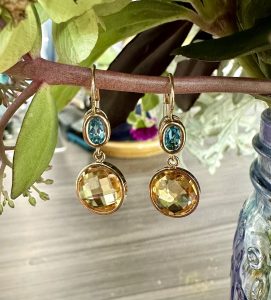
As the crisp Fall days officially settle in and the world becomes bathed in beautiful shades of orange and gold, there’s no better time to celebrate the gemstone that captures that same radiance and warmth. Citrine, with its sunshine-like sparkle and welcoming glow, is one of November’s two beautiful birthstones (the other being Imperial Topaz, which is a golden-yellow variety of that gemstone, and very similar in color to citrine).
Citrines are far more than a pretty pop of color, however. From its interesting geological and historical beginnings to its important symbolism, citrine (like all gemstones) has a story worth exploring. Whether you are a November birthday girl, a gemstone enthusiast, or simply someone who loves some sunny sparkle, read on to discover the timeless beauty, history, and fascinating facts behind the golden gem.
What is Citrine?
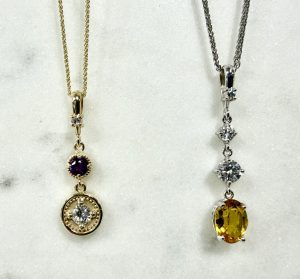
Becca used a client’s existing citrine gemstone to design this stunning diamond and citrine pendant, a true heirloom that is sure to be cherished by her family for generations.
Citrine is a variety of quartz, one of the most plentiful minerals in Earth’s crust. Citrine ranges in color from a pale, lemony yellow to a rich golden honey or amber color. In fact, one of citrines most appealing qualities is its range of color: from a delicate, lemon-colored stone to a rich, amber-colored stone that looks like liquid honey, citrine comes in shades that will appeal to anyone who loves the color yellow. This gemstone is vitreous, which means it has a glass-like shine when polished. Not only is citrine one of November’s official birthstones, it is also the traditional gift for a 13th wedding anniversary. Natural citrine gets its unique color from both trace amounts of iron, as well as the way that the crystal’s structure and impurities interact with both radiation and geological conditions over time.
Citrine ranks a 7 on the Moh’s Scale of Hardness, which means that it is a softer gemstone. While it is decently durable for use in jewelry, it is also the kind of stone that should be worn with care to avoid scratching and chipping (especially if worn in a ring). It’s also worth mentioning that household dust and sand can contain quartz, so repetitious contact with particles that contain quartz can cause wear and tear over time. Citrine can also fracture if struck, and can be sensitive to extreme changes in temperature. Never wear your citrine jewelry when you are doing activities such as cleaning, showering, working out, gardening, swimming, etc.–and, as mentioned in previous blog posts, this is just good advice for all jewelry!
A Gemstone with a Double Identity
Did you know that most gemstones sold as citrines today began their lives as amethysts? Well, it’s true!
Because natural citrine is somewhat rare, some of the citrine that is commercially available today in jewelry stores is created by very carefully heating purple amethysts (February’s birthstone!), which is another variety of quartz. The heat actually changes the color of the stone, creating what we recognize as citrine! It is very important to note that this is a recognized gemstone treatment, and not at all the same thing as making an imitation of the stone out of a different material! You also can’t confuse these stones with ametrine, which is the gemstone that occurs when natural purple amethyst and golden citrine occur in the same crystal, creating a unique purple-and-gold stone. Heat-treated amethyst is still genuine quartz, its color origin is just different. These stones are known as heat-treated citrines—a quartz material that has been treated to change its color. It is also worth noting that quartz, like diamonds and other gemstones, can be grown in a lab instead of mined from the Earth! When sourced naturally, citrines can be found in Bolivia, Brazil, Madagascar, Spain, Mexico, and Uruguay.
The History of Citrines, and How to Care For Them

This birthstone band we recently completed for a client features a stunning citrine in the center
Quartz has a long history of being used in jewelry. Interestingly enough, citrine has a bit of a confusing history: before certain advances in the field of modern gemology, citrine and Imperial Topaz were often mistaken for each other due to similar golden colors (Imperial Topaz was actually the first recognized birthstone for November; citrine followed in 1952 as a more affordable golden-colored birthstone option) . Citrine became popular in Scottish jewelry during the Victorian era–to this day, you can find certain estate pieces of jewelry featuring this golden gem.
While citrine isn’t difficult to care for, you will want to make sure you are cleaning it regularly to maintain its unique shine. To clean your citrine jewelry, start with warm, soapy water, then soak your pieces for 10-15 minutes. Using a baby toothbrush, gently scrub your jewelry (make sure to clean around the prongs, around the stone, and underneath the setting to really target main areas where grime can tend to collect!), then rinse under clean, lukewarm water and dry using a soft cloth, and let your jewelry air dry completely before storing it. Make sure to store your citrine pieces separately from your other pieces to prevent scratching, and while you must avoid steaming your citrine jewelry to avoid cracking it, make sure to take your pieces to a jeweler every so often so they can be professionally checked!
Before You Go…
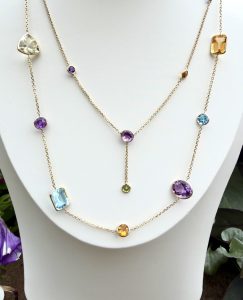
These beautiful necklaces are part of our Estate and Consignment Collection, and they both feature a sparkling assortment of different gemstones–including citrine! Priced at just $700 (center lariat-style necklace) and $800 (larger stone necklace), these beautiful pieces would make the perfect gift for anyone who celebrates a birthday or anniversary in November!
Citrine may be known as November’s birthstone, but its warm glow makes it a gemstone to celebrate every month of the year. We love that citrine offers so many possibilities–it can be delicate and understated, bold and dramatic, vintage-inspired, or completely modern. If you’ve been looking for the perfect sunny stone to add some sparkle to your jewelry collection, citrine might just be the one you have been searching for!
Happy November, and keep on sparkling!