
June is finally here–the official start of Summer–and I think it is safe to say that we have all been waiting for this month with a sense of excitement and anticipation. The long-awaited end of the school year, the promise of long nights full of play and rest, the magic of vacations, the taste of hot dogs and s’mores enjoyed around the campfire, and so much more evoke a sense of peace and nostalgia to which the rest of the year can only aspire. June is also a special month, as it has not one but three beautiful birthstones, pearls, alexandrites, and moonstones. In this month’s blog post, we will be examining the most well-known of June’s birthstones, the perfect pearl.
What are Pearls?
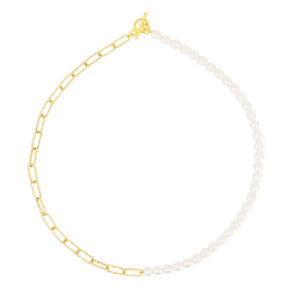
A beautiful and budget-friendly option, we have this lovely in-stock half yellow gold plated .925 sterling silver paperclip and half pearl necklace for $98!
A pearl is an organic gemstone formed inside mollusks such as oysters and muscles. Unlike many other gemstones, pearls are unique in that they are created by living organisms–which, for many, makes them extra special. Pearls form when an irritant enters the mollusk, and layers of nacre build up around it over time, eventually creating a pearl. Nacre is the substance which gives pearls their unique luster, or irridescent “glow”.
The History of Pearls
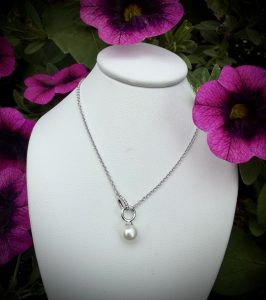
Pearl necklaces don’t always have to be a classic strand! This elegant piece features a glowing pearl lovingly embraced by glittering pave diamonds and 14K white gold. Sure to be loved for generations, this necklace is priced incredibly at $1,100
Did you know that there was a time in history where pearls were considered more valuable than diamonds? Ancient Egyptians prized pearls enough that they were buried with royalty, Ancient Romans associated them with wealth and power, and in Ancient China, pearls represented wisdom and protection. Persian legend even has it that pearls were formed when rainbows kissed the earth–a sweet sentiment, if factually inaccurate. Pearls were worn almost exclusively by royalty in the Middle Ages due to the rarity of natural pearls, and the elite would adorn everything from gowns to crowns with this precious gem.
Types of Pearls
To understand the formation of pearls, it is important to understand their different types. Natural pearls form without human intervention, and are extremely rare today. Some characteristics of natural pearls is that they are very expensive, usually irregular rather than uniform, they are highly valued by collectors, mostly sold at auction or antique dealers. Cultured pearls constitute the majority of the pearls available on the market today. This type of pearl is formed when a technician intentionally inserts a nucleus into the mollusk to stimulate pearl formation–it is important to note that cultured pearls are still real pearls.
Pearls can be broken down into major categories, which ensures that there are pearls that appeal to every type of collector:
- Akoya Pearls
- Classic, white round pearls known for extreme elegance and a stunning luster
- Usually white or cream in color
- High, mirror-like shine
- Typical sizes range from 2mm-10mm
- South Sea Pearls
- Among the largest and most luxurious pearls available
- Colors range from white, to silver, to even a more golden colored pearl
- South Sea Pearls can be as large as 20 mm!
- They tend to be expensive due to a variety of factors, including their thick nacre, long growth period, large oyster size, and lower production volume
- Tahitian Pearls
- Famous for their naturally dark colors, which can include black, peacock green, charcoal, aubergine, and silver-gray
- Freshwater Pearls
- Highly affordable and versatile while still being beautiful; excellent value
- Can be found in a wide range of shapes
- Huge color variety
- Durable for daily wear
As surprising as this may be to some, pearls also come in a variety of shapes–not just round (which is the most traditional and valuable shape)! Baroque pearls are highly irregular, extremely unique pearls that can come in a wide variety of shapes, and are often used in artistic, distinctive jewelry designs. Button pearls are a flatter shape, and are very popular in earring designs, whereas oval pearls are an excellent choice for pendants due to their elongated shapes. The unique teardrop shape of drop pearls are also perfect for pendants, and are a popular choice for bridal jewelry.
How is the Value of a Pearl Determined, and How Should They Be Cared For?
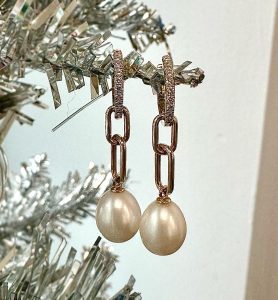
These stunning earrings feature a sizable oval pearl dripping from a trendy 14KY gold paperclip setting. What makes these earrings even more unique? The pave diamond encrusted hoop at the top is actually detachable, meaning you can wear these earrings in two ways: As petite huggie hoops, or as a statement earring with the pearls attached. Unbelievably, this two-in-one pair of earrings is priced at only $1,975
As mentioned previously, a pearl’s value is determined, in large part, by it’s luster. The luster on a high-quality pearl needs to display the following characteristics: sharp reflections, a deep “glow”, bright surface, and a dimensional appearance. A lack of luster can make pearls appear chalky, dull, or “flat” in contrast to high-quality pearl’s iridescence.
The quality of a pearl’s luster is not the only way that the value of a pearl is determined, however. Pearls are graded according to several factors: luster, surface quality, shape, color, matching, nacre thickness, and size. Pearl size is measured in millimeters, as are most stones, and jewelers have their own unique way of grading pearl quality.
Pearls are delicate stones, and need special care to preserve their shine. When wearing pearl jewelry, you should avoid exposing them to perfume, hairspray, lotions, cosmetics, harsh cleaners, or ultrasonic cleaners. After wear, you should plan to wipe down your pearls, store them separately from other jewelry, and have them professionally restrung from time to time. It’s also advisable to wear your pearls often to preserve their beauty. Since pearls are porous, they rely on the natural oils from your skin to preserve their luster. Pearls can actually dry out, turn yellow, or crack if packed away for too long! To ensure that your pearl jewelry is properly cared for, following the classic “Last on, first off” rule is always a good idea.
How Should I Style Pearls?
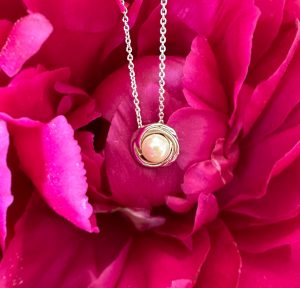
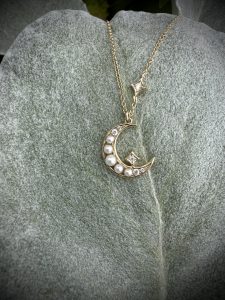
One of the most timeless and versatile gemstones, pearls can be used in far more styles than just a classic strand, as seen in this delicate and minimalist pendant.
Gone are the days where pearls are seen as dated. Pearl jewelry is an extremely trendy and modern choice, with a wide variety of uses and ways to wear. Some pearl trends that are currently wide-spread include tiny seed pearls layered with chunky, maximalist chains, baroque pearl jewelry, mismatched pearl earrings, pearls mixed with silver metal, pearls set on leather cords, pearl chokers to be worn with a variety of outfits, stacks of pearl necklaces, pearl jewelry mixed with casual streetwear, pearl-embellished claw clips, minimalist pearl huggie hoop earrings, and much more. Modern pearl styling usually involves asymmetry in design, layering, mixed metals, irregular pearl shapes, contrasting pearls with casual clothing, and an eclectic mix of both high and low fashion. Bottom line–there is no longer a “right” and a “wrong” way to wear pearls!
In conclusion, pearls are in their comeback era. There is a type, a shape, and a color of pearl for every wearer, and it has been so exciting to watch new generations discover this incredible gemstone and make it their own unique fashion statement. So here’s to the June babies (such as this author), and to the perfect pearl, one of nature’s loveliest miracles.